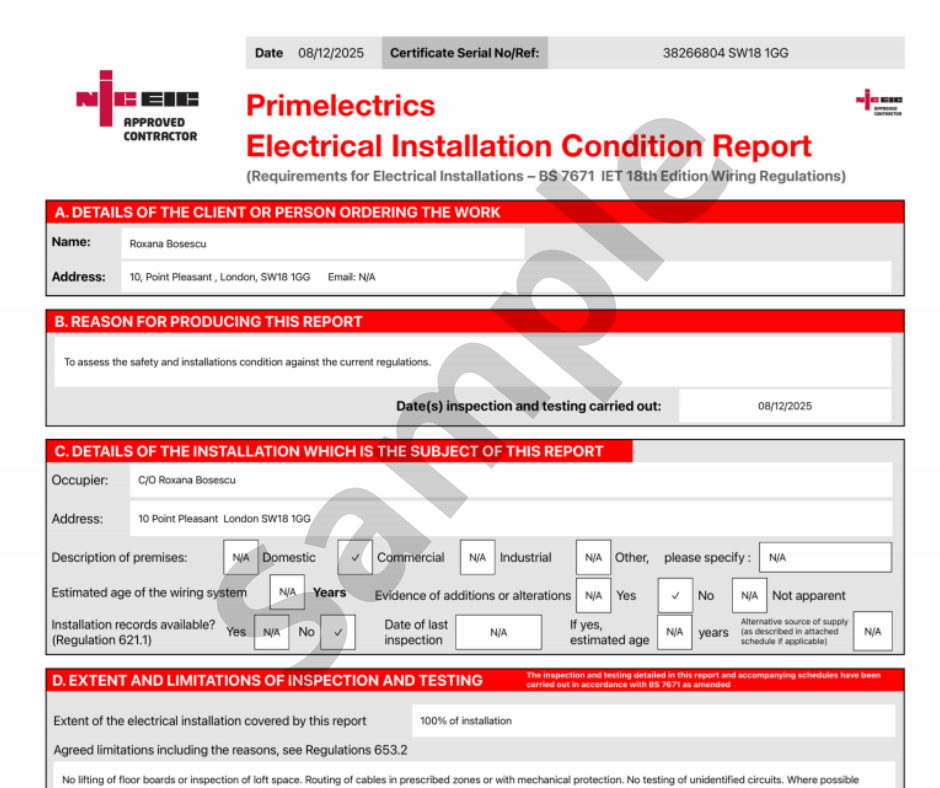
An EICR Certificate London plays a central role for landlords and property managers across the capital. An EICR Certificate London confirms the safety condition of fixed electrical installations and supports compliance under housing regulations. Clear awareness of the EICR legal requirement helps landlords avoid enforcement action. Rental properties must keep a valid Inspection Report and present documentation when requested by local authorities. Council housing enforcement data shows regular audits across London, especially within high-density rental areas. EICR Compliance London remains a key focus during inspections. A structured approach defines the EICR inspection process. Qualified electricians assess consumer units, wiring systems, sockets, switches, and earthing arrangements. Findings appear within a formal Inspection Report that uses recognized safety classifications. Electrical Safety-First research shows properties with routine inspections experience fewer serious electrical failures. Many property owners search for information related to EICR cost in London. Costs vary based on layout, access, and system condition. Accurate figures require a professional review, so direct contact with an inspection provider remains the most reliable option. A practical landlord EICR checklist further supports preparation and smooth compliance for London rental properties.
Key Takeaways
1. Legal compliance reduces exposure to penalties, enforcement notices, and rental restrictions across regulated properties
- Routine inspections help identify hidden electrical faults before safety risks increase into serious incidents
- Qualified professionals deliver accurate assessments that meet recognized national safety standards
- Clear classification codes support faster decisions on urgent repairs and planned improvements
- Quick corrective work lowers long-term maintenance disruption and unexpected electrical failures
- Well-maintained records support smoother audits and faster responses to authority requests
- Older installations often require closer attention due to outdated protection and wear over time
- Follow-up verification confirms corrective work completion and restores full safety status
- Transparent safety documentation strengthens trust between owners, managers, and occupants
- Expert guidance streamlines compliance steps and reduces uncertainty throughout the process
How Much Does an EICR Certificate Cost in London
Clarity around EICR Certificate London pricing helps landlords and property owners plan compliance steps. Pricing structure depends on the inspection scope rather than a fixed figure. Industry surveys from the UK electrical trade structure confirm a wide variation across London due to property diversity. Search trends also show a strong interest in EICR cost in London among rental property owners.
Average Price Ranges
General pricing guidance follows property type and usage classification. Industry benchmarks highlight consistent differences across categories.
Flats vs houses
- Flats usually require less inspection time
- Access to circuits often remains straightforward
- Houses often contain more distribution points
- Detached homes usually involve an extended inspection scope
Residential vs commercial
- Residential properties follow standard inspection depth
- Commercial sites involve higher system complexity
- Business premises require stricter compliance checks
- Usage load influences inspection duration
Electrical contractor reports confirm that property classification remains a primary pricing factor for an EICR Certificate London.
What Affects the Cost
Multiple technical elements influence final pricing outcomes. Electrical Safety-First research links inspection duration directly to system layout.
Property size
- Larger floor areas require extended circuit checks
- Multi-level properties increase inspection time
Number of circuits
- Higher circuit counts raise inspection workload
- Distribution board configuration affects testing steps
Condition of electrics
- Older installations require deeper assessment
- Visible defects increase reporting complexity
Industry data shows well-maintained systems support smoother Electrical Inspection Report outcomes and faster completion under EICR Compliance London standards.
| Property Type | Usage | Estimated Cost Range |
|---|---|---|
| Flat | Residential | £80 to £150 |
| House | Residential | £150 to £300 |
| Small commercial unit | Commercial | £180 to £250 |
| Medium commercial property | Commercial | £220 to £350 |
Accurate EICR Certificate London figures depend on circuit volume and system layout under the EICR inspection process. Direct contact with a qualified provider supports precise guidance aligned with EICR legal requirements and landlord EICR checklist obligations.
Understanding EICR Report Codes C1, C2, C3
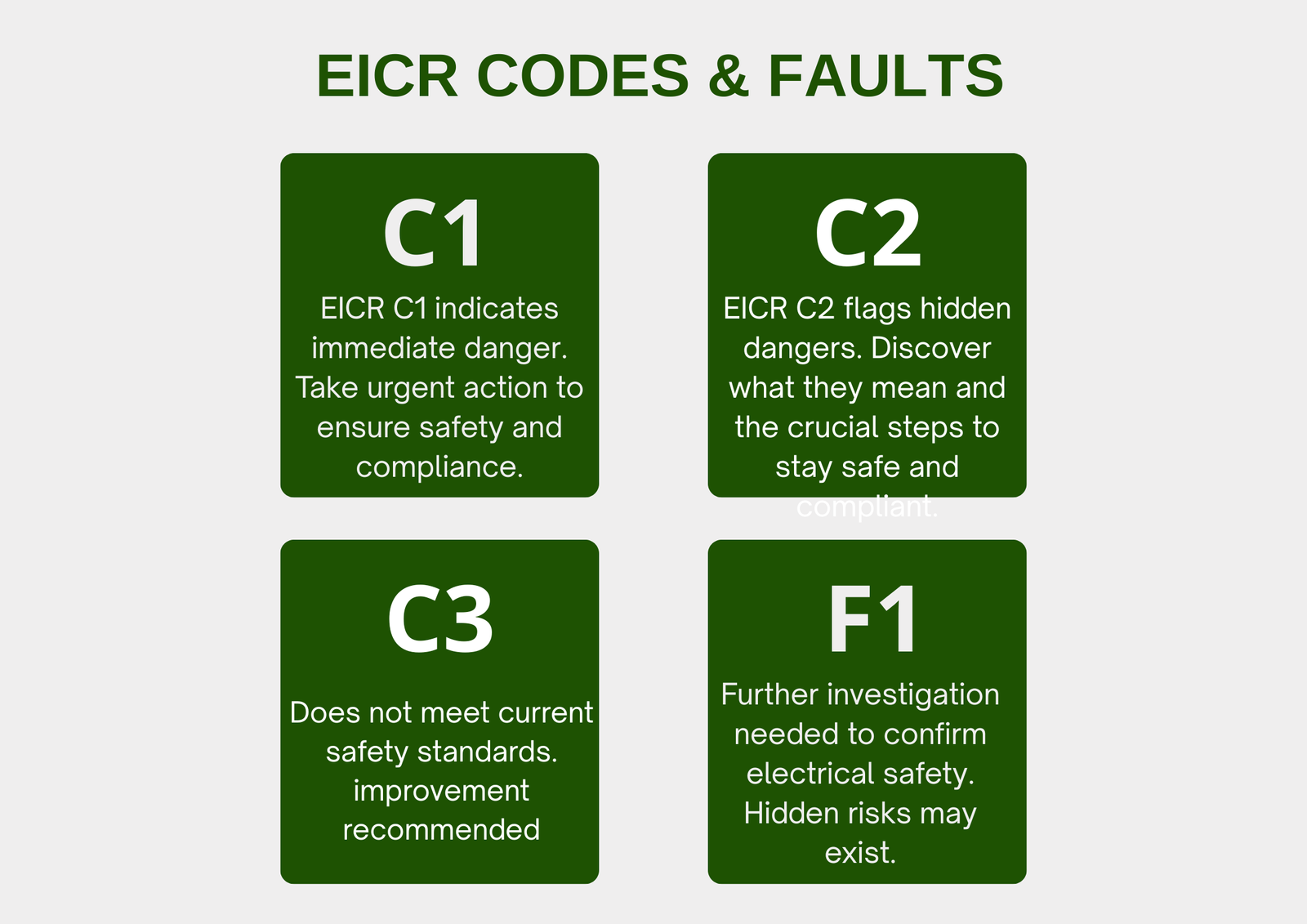
Clear interpretation of EICR report codes supports fast decision-making after an electrical inspection. Certified electricians assign each code based on risk level and urgency. Official guidance from the IET confirms that correct interpretation reduces safety incidents across residential properties. C1 highlights immediate danger within the electrical system. Electric shock or fire risk exists at the time of inspection. Urgent action must follow to remove the risk. Electrical Safety-First data links C1 faults to a high percentage of domestic fire callouts in London. Common examples include exposed live conductors or severe overheating within consumer units. C2 identifies a potentially dangerous condition. Risk may increase under certain conditions, such as load stress or continued use. Repairs should follow without delay. Industry inspection data shows that many older rental properties receive C2 classifications due to outdated protection devices. C3 confirms that safety remains acceptable, but improvements are advised. No immediate danger exists. Upgrades help align installations with current standards. Examples include modern RCD protection or older wiring colors. Visual support, such as a small table or infographic, helps landlords compare codes quickly. Explanations written by certified electricians add trust and accuracy. Professional interpretation ensures correct response and long-term electrical safety.
What If Your Property Fails an EICR
A failed EICR Certificate London indicates that electrical safety standards are not met at the time of inspection. An Electrical Inspection Report highlights specific issues through C1 or C2 codes. London housing enforcement data confirms that most failures relate to preventable defects rather than complex faults. Common reasons for failure often include outdated consumer units, inadequate earthing, damaged wiring, overloaded circuits, and the absence of modern RCD protection. Electrical Safety-First statistics show that older rental properties account for a high percentage of negative outcomes under EICR Compliance reviews. Typical remedial work focuses on risk removal and system improvement. Certified electricians often replace faulty components, upgrade protective devices, repair damaged circuits, and correct bonding issues. Landlord EICR London guidance confirms that only qualified professionals should carry out remedial actions to maintain report validity. Regulations set clear expectations on how quickly issues must be fixed. C1 issues require immediate action, while C2 issues demand prompt resolution within a defined period. Local authority guidance supports strict timelines to protect occupants. The re-inspection process follows once remedial work concludes. An updated Electrical Inspection confirms compliance and supports the issuance of an Electrical Safety Certificate London. Professional teams help landlords reach compliance efficiently and with minimal disruption through clear guidance and structured support.
How an EICR Certificate Protects Landlords from Legal and Financial Risk
An EICR Certificate London acts as a safeguard against legal and financial exposure for property owners. Regulatory enforcement across London places strong emphasis on documented electrical safety. Local authority housing data shows enforcement action often increases when an Electrical Inspection Report is missing or expired. Valid documentation shifts risk away from landlords and responsible property management. Outdated or missing records increase liability risk. Landlord EICR London rules assign clear responsibility for electrical safety. Injury claims, fire investigations, and tenant disputes frequently reference inspection history. Council case studies show penalties and enforcement notices often follow documentation gaps rather than isolated faults. Insurance protection also links directly to compliance. Providers commonly request an Electrical Safety Certificate London after incidents such as fire or equipment damage. Industry insurance reports confirm that verified EICR Compliance London reduces claim disputes and supports faster resolution. Absence of proof may weaken claim outcomes. Disputes with tenants or councils rely heavily on evidence. A valid EICR Certificate in London demonstrates reasonable care and regulatory awareness. Councils accept recent Electrical Inspection during audits or complaint reviews. Clear records strengthen a landlord’s position during enforcement action and help resolve issues efficiently. This approach reframes electrical inspections as protection rather than obligation, which aligns with high-intent landlord priorities.
EICR Certificate vs Other Property Safety Certificates
A clear understanding of property safety certificates helps landlords and property managers meet legal duties without confusion. Each certificate covers a different safety area and applies to specific property types. Government housing guidance confirms that failure to hold the correct certification often leads to enforcement action during inspections. An EICR Certificate London focuses on fixed electrical installations. Wiring systems, consumer units, sockets, switches, and earthing arrangements fall under review. EICR Compliance London applies to rental and commercial properties, with local authorities requesting a valid Electrical Inspection Report during audits. Gas Safety certification is required only where gas appliances exist. Engineers assess boilers, cookers, and pipework. Rental properties must hold valid gas documentation where applicable. Health and Safety Executive data links gas safety checks to reduced carbon monoxide incidents. Fire Safety certification covers fire risk management. Escape routes, alarms, signage, and emergency lighting form part of the assessment. HMOs and commercial premises carry stricter obligations under fire safety regulations.
| Certificate | What It Covers | Required For |
|---|---|---|
| EICR | Electrical safety | Rental and commercial |
| Gas Safety | Gas appliances | Rental |
| Fire Safety | Fire risk | HMOs and commercial |
Certified professionals recommend holding all applicable certificates to support full compliance. Combined documentation strengthens safety assurance and simplifies local authority reviews across London properties.
How Long Does an EICR Certificate Take from Booking to Completion
Clear expectations around timelines help landlords plan access and avoid compliance delays. An EICR Certificate London follows a defined process from initial booking to report delivery. London trade body surveys show most inspections progress smoothly when access and documentation remain organized. Booking timeframes vary across boroughs due to demand and property type. Industry data from NICEIC registered contractors shows average booking availability ranges from a few days to short waiting periods during peak rental cycles. Advance scheduling reduces disruption and supports smoother EICR Compliance London outcomes. On-site inspection duration depends on size and layout. Flats usually require less time than larger homes. Electrical Safety-First guidance confirms that most residential inspections can be completed within a standard visit when systems remain accessible and free from major faults. Report delivery follows after assessment and review. Digital Electrical Inspection Reports often reach landlords shortly after completion. Certified electricians verify findings before release to ensure accuracy and regulatory alignment. Local authority audits accept electronic documentation without delay. Delays may occur due to restricted access, unresolved safety issues, or required remedial work. Council enforcement statistics show access problems remain the most common cause of extended timelines. A completed EICR Certificate London confirms readiness for tenancy and provides documented protection once issued.

Tenants have a role to play in keeping themselves safe from electrical hazards.
If you are a tenant and you believe that your property does not meet the required standards, you should contact your landlord and request an EICR. If your landlord does not take action, you can report them to your local authority.
It is important that the landlord use a competent person to carry out the EICR and that you keep up to date with the latest guidance. This will help to ensure that your property is safe and compliant with the law.
The Regulations come into force on the 1st July 2020, and from this date, all new tenancy agreements must include an electrical safety certificate.
An electrical safety certificate is a document that proves that the electrical installation in a property has been inspected and tested by a qualified electrician and is safe to use.
EICR Certificate can be issued for a property for a maximum of 5 years, However, it depends on the condition of electrical wiring and fixed fixtures, for how long the certificate will be valid, it is completely subjective to the electrician for how long he wants to pass the certificate ranging from 1 to 5 years after assessing the property, if the property electrics are in good condition it is usually issued a certificate for 5 years. However, if any faults or issues are found during these year/s, it is recommended that these are rectified as soon as possible.
The electrical testing of a property can takes up to an hour, depending on the size and complexity of the electrical system. Testing is typically done by one of our Landlord Certificate London licensed electrician, who will first assess the electrical system and then carry out the necessary tests.
Only a registered electrician should conduct electrical inspections reports or certificates, as they must be done by an accredited, competent individual. They will verify the electrics’ condition against the UK standard for electrical installations, BS 7671 – Requirements for Electrical Installations (IEE Wiring Regulations), to ensure that they are in good working order. An Electrician should be either NAPIT or NICEIC Qualified in order to be eligible to do the testing.